
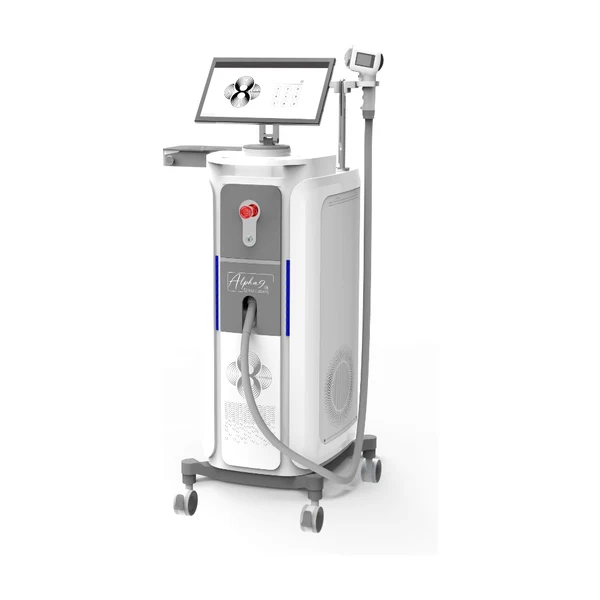
Diode or alexandrite: what should a practitioner weigh up?
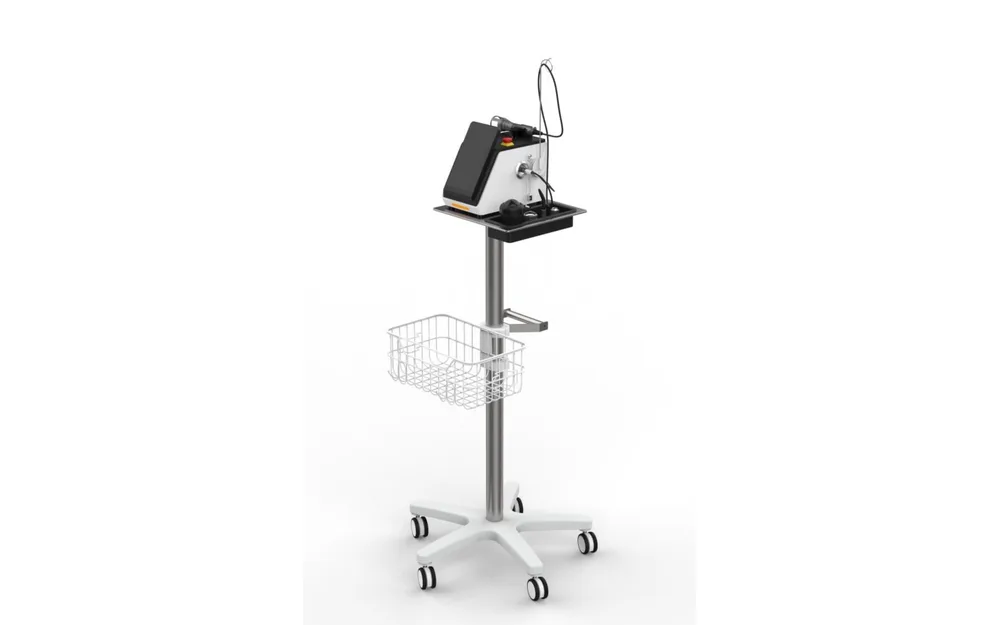
Diode or alexandrite? The question comes up in every professional discussion about hair removal equipment — and the answers are often emotional, because each camp defends its own choice. We have already published a comparison written for clients (read it here); this article looks at the same question from the other side: what a practitioner and business owner should weigh up when deciding which technology to put their money into.
We will look not only at how effective the treatment is but at what the brochures pass over: running costs, the device's working life, the structure of your client flow, and the reality of service and support.
The technological difference in one minute
Both technologies work on the same principle — the melanin in the hair absorbs light energy, and heat acts on the follicle. What differs is the light source and the wavelength: an alexandrite laser works at 755 nm, which melanin absorbs very strongly, while diode devices usually work around 808 nm — a more versatile range that penetrates deeper and is gentler on the surface of the skin. We cover the physics of wavelengths in detail in the article "755 nm, 808 nm and 1064 nm: how do laser wavelengths differ?".
Criterion 1: whose skin will you be working on
The strong absorption of 755 nm by melanin is a double-edged sword. It is effective on fine hair and lighter shades of dark hair, but tanned or darker skin absorbs that energy just as eagerly, which means a narrower window for safe work. The diode wavelength is gentler on the surface of the skin, so the range of clients you can serve safely is wider — in a market where a large share of clients are tanned in summer, that is a very practical argument: you do not have to pause treatment courses for the summer season.
Criterion 2: running costs and working life
From a business point of view this is often the most important criterion, and the least often discussed. Diode modules have a long pulse life and the technology itself has a simpler construction, so diode devices cost less to run and maintain. Calculate the cost per treatment and diode technology usually wins — and cost per treatment is what governs your margin, which we work through in the article on equipment payback.
Do not overlook day-to-day maintenance either: every device needs a clean cooling system and water filters changed on time — the full checklist is in our maintenance guide.
Criterion 3: working speed and ergonomics
Your daily income = number of clients × price per treatment. So the handpiece window and its power are financial parameters, directly. Modern diode devices let you work fast: CLens has a 1200 W handpiece with a 15×40 mm window for large areas and a separate 600 W handpiece with a 12×12 mm window for precision work — a leg treatment is completed far faster than with a small window, and precision areas lose nothing.
Criterion 4: client comfort
Clients coming back is the foundation of a course-based service, and comfort affects it directly. What decides comfort is less the name of the technology than the cooling system: good contact cooling actively chills the skin throughout the treatment, and the client feels only flicks of warmth. Our devices use sapphire cooling technology; we explain why it matters so much in a separate article, and we cover the question of sensation for clients in the post "Is it really painful?".
Criterion 5: service and the reality of your supplier
Technology without service is a risk. Before buying any device, establish who carries out warranty repairs and how quickly, whether the supplier holds spare parts, and whether they are a direct representative of the manufacturer or merely an intermediary. We provide our clients with professional service throughout the warranty and post-warranty period, and free telephone support for the first three months after delivery. The full method for checking offers is in the guide "How to compare different aesthetic equipment offers".
The comparison, summarised for practitioners
| Criterion | Alexandrite (755 nm) | Diode (~808 nm) |
|---|---|---|
| Range of skin types | Narrower; careful with tanned skin | Wider; works through the summer season |
| Running costs | Higher | Lower, with long diode life |
| Cost per treatment | Higher | Lower |
| Working speed | Depends on the model | High, with wide-window handpieces |
| Size of investment | Usually larger | More rational for a new business |
Three diode routes, by stage of business
- Starting out or working mobile — Portable DI (€8,800): compact, easy to move, fully functional.
- Want the latest generation — the laser with built-in artificial intelligence (€11,210): the AI camera helps choose settings and reduces the risk of human error.
- High volume and maximum throughput — CLens (€14,800): two specialised handpieces for the whole range of treatments.
You can compare all three in a table or get a recommendation from the selection guide.
Total cost of ownership: calculate over five years
The professional way to compare technologies is not by purchase price but by total cost of ownership across the device's whole life. Build this table for both options:
| Line | What to ask the supplier |
|---|---|
| Purchase price | With training and installation, or without? |
| Consumables | Filters, gels, specific materials — the annual figure |
| Module life | How many pulses is it rated for, and what does replacement cost? |
| Servicing | The price of an annual check, and repair rates after the warranty |
| Downtime risk | How quickly are repairs actually done? Every day is lost income |
Add up five years of those lines and the difference between technologies often looks entirely unlike a straight price comparison — and this is precisely where diode technology, with its long diode life, usually shows to best advantage.
The team perspective: who will work with the device
If you plan to grow, judge the technology through the lens of your team as well. Questions to ask yourself:
- How long does it take to train a new member of staff? The simpler and more forgiving the device, the faster a newcomer becomes independent. AI camera solutions such as our laser with built-in AI give a real advantage here — the technology takes on part of the responsibility for choosing settings;
- What happens when a practitioner leaves? With standardised technology and clear protocols, the quality of the service does not depend on one person;
- What does training an extra member of staff cost? With us it is €400 per person, and refresher practice later is €100 an hour. All the terms are set out on the page about working together.
The marketing angle: turning technology into sales
The choice of technology is a communication decision too. Clients increasingly ask what device you work with, so your choice has to sell itself:
- Comfort as your banner. "A treatment with sapphire cooling — just a feeling of warmth" is a message that answers your clients' biggest fear directly;
- An uninterrupted season. Being able to continue a course through the summer (with responsible sun protection) is an argument every client understands;
- Speed. "Legs done in 20–30 minutes" is a specific, checkable promise for busy clients;
- Educational content. Links to explanatory articles (feel free to share our article on sensation) build the image of an expert and save consultation time.
A decision algorithm: six questions to ask yourself
- What range of skin types and hair will my clients bring — will I need to work on tanned skin in summer?
- How many clients a day am I planning for a year from now — will the device's speed hold up?
- What is my cost per treatment and what does it mean for my margin (work it out with the calculator)?
- Who repairs the device and how quickly — is the supplier a direct representative?
- What will training cost, now and as I expand?
- Can I see the device working before I buy?
If you can answer all six with confidence, the decision is essentially made. If not, we will gather the missing answers together in a consultation.
The used market: why "an alexandrite at half price" is not an opportunity
Classified sites are full of used devices "at a good price" — often precisely the older devices from the expensive class. Before you are tempted, consider what you are actually buying: an unknown amount of module life left (the pulse counter is not always reliable), no training, no warranty and usually no service — manufacturers' representatives do not service devices bought privately. Add the possible need for recalibration and questions about documentation, and "half price" becomes a lottery in which you are staking your business's reputation.
If your budget is tight, the more rational route is a new compact device with full support (Portable DI, for instance) or financing, which lets you buy a higher-throughput model with no up-front investment.
Already have an alexandrite? How to plan the transition
If you work with an alexandrite device today, nothing needs changing in a hurry — let a working tool earn. But when planning ahead it is worth:
- recording your actual running costs and downtime — that is the data behind your decision;
- watching how many clients you lose over the summer and to skin-type limitations;
- timing the transition so that the new device arrives before the high season while the old one still covers the changeover;
- considering a two-device model for a growing practice — a second practitioner and a second treatment room often pay for themselves faster than you would expect (the method for calculating that is here).
The essentials at a glance
- The business decision turns not on the name of the technology but on skin-type range, running costs, speed and service;
- Diode technology is the most rational choice for most practices today — on cost per treatment, working life and the ability to work through summer;
- Calculate five years of ownership costs, not the price on the label;
- A used device with no service and no documentation is a lottery, not an opportunity;
- Before deciding, see the device working — book a demonstration.
Frequently asked questions
Do clients ask about the technology?
Yes, and increasingly so — clients arrive having read up online. Being able to explain the differences calmly matters; for that you can use our client-facing articles on discomfort and on comparing the technologies.
Does a diode laser cope with light hair?
Like any melanin-based technology, no. Light and grey hair needs electrolysis; practices that have both technologies can offer a complete result. More in "When do you need both technologies?".
Where can the devices be seen in person?
At our studio in Kaunas, Puodžių g. 10-4 — arrange a time in advance and you can try the treatments and compare the devices close up. Book here.
Is it worth having both technologies in one practice?
For a hair removal business, duplicating two light-based technologies rarely pays — a good diode device covers the whole core range. The more rational direction for growth is to add equipment that works on a different principle: electrolysis for light hair, or body treatment devices. That way a second investment creates a new service and a new income line rather than duplicating the existing one.
Choosing between specific models? Send us both offers — in a consultation we will analyse them together, openly, including the parameters you will not find in the brochures. The consultation is free, and our position is transparent: if the most rational solution in your case turns out to be something other than our own offer, we will say so.