
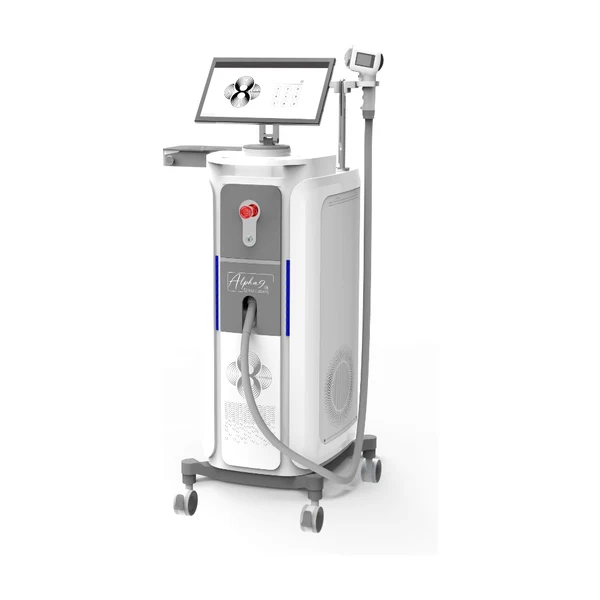
Diode vs alexandrite laser: what should a client know?
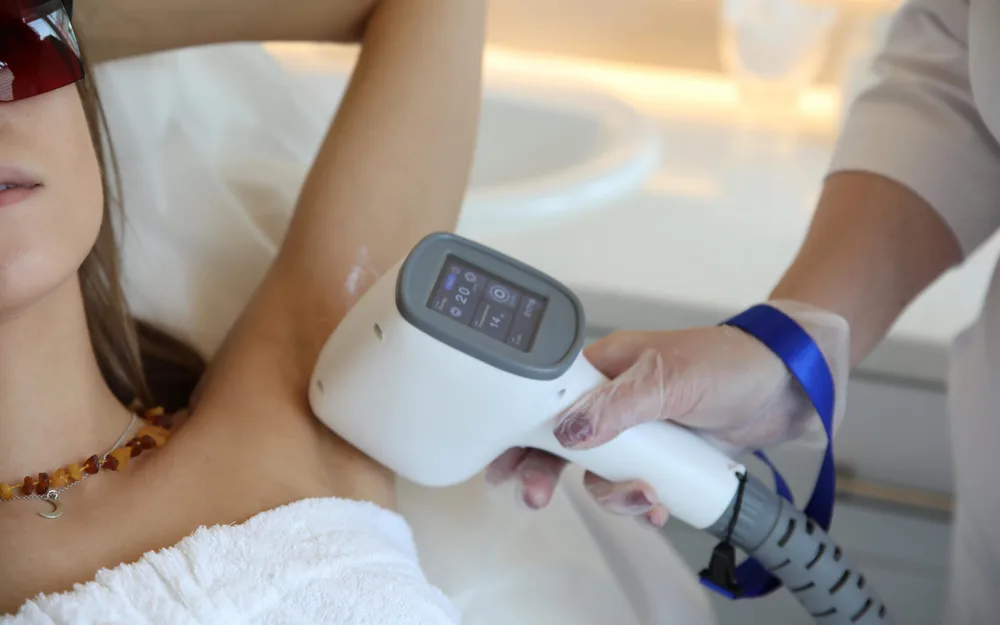
When you are choosing a laser hair removal service, the sheer number of offers can be confusing. At first glance every treatment looks much the same, but the technology used creates real differences — differences you, the client, will feel. The two most common types of laser in salons are the diode and the alexandrite.
So, is there a difference for the client? Without doubt. Let us look at the aspects that will directly affect your experience, your safety and the final result.
The differences you will actually feel
1. Sensation and comfort
This is one of the most important differences. Because of its shorter wavelength and harsher effect on the skin's surface, treatment with an alexandrite laser is considerably more painful. Modern diode lasers with a built-in contact cooling system, by contrast, make the treatment far more comfortable. You feel only a slight tingling and warmth — we describe the sensations in detail in "Is it really painful?".
- What this means for the client: less stress and less discomfort during the treatment.
2. Safety for your skin
The alexandrite laser is effective only on very light skin (phototypes I–III). Because of the high risk of damaging the skin's pigment, it cannot be used on tanned or naturally darker skin. Modern diode lasers — particularly three-wavelength models — are versatile and safe across a wide range of skin phototypes (I–V).
- What this means for the client: greater safety and a lower risk of burns or pigment spots. The treatment can be carried out even in summer, with responsible sun protection.
3. Treatment speed
Modern diode lasers often have a larger handpiece window and "In-Motion" technology, which lets the practitioner work quickly and without interruption. Alexandrite technology often calls for more painstaking, slower work.
- What this means for the client: less time spent in the salon. Treating the legs with a diode laser can take just 20–30 minutes instead of 45 or more.
4. The price of the service
Historically, alexandrite lasers were more expensive, so salon prices were higher too. Diode technology is newer and more efficient, which makes a more attractive price possible.
- What this means for the client: an effective service at a more accessible price, and savings across the whole course of treatments.
Comparison table: the client's experience
| Criterion | Diode laser (modern) | Alexandrite laser |
| Sensation | Minimal discomfort, gentle warmth | Moderate to strong pain, a sharp sting |
| Safety | Safe for almost every skin type | Light, untanned skin only |
| Speed | Very fast treatment | Slower treatment |
| Price | More accessible | More expensive |
Where the "gold standard" myth came from
The alexandrite laser earned its reputation a decade and more ago, when diode technology was still young: at that time the 755 nm wavelength really was the most effective tool for light skin with dark hair. But technology does not stand still — today's diode devices, with powerful handpieces and sapphire cooling, achieve the same result for a wider range of clients and with incomparably more comfort. How the different wavelengths work, and why 808 nm became the salon standard, is explained in plain language in "755 nm, 808 nm and 1064 nm: how the wavelengths differ".
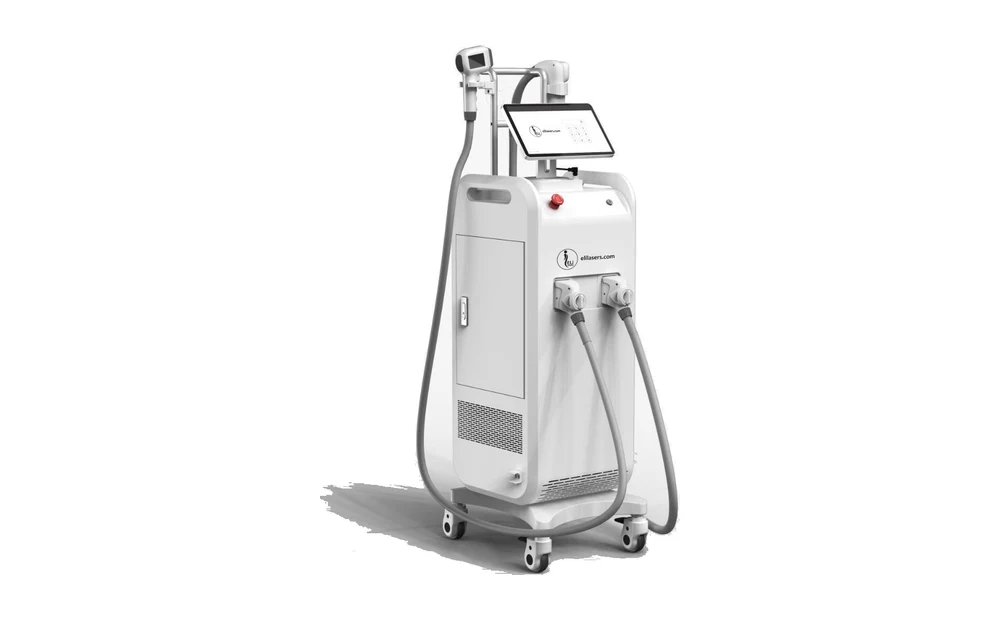
What a course of treatments looks like
Whatever the technology, laser hair removal is a course, not a single visit: hair grows in phases, and the laser only affects follicles in the active phase. A full result therefore takes 6–10 treatments a few weeks apart — the practitioner draws up the exact plan during the consultation. With every treatment there is less hair and it grows finer, so the course gets quicker and more pleasant as it goes.
It is worth knowing the limits of the method too: the laser works through pigment, so it is ineffective on very light or grey hair. In that case electrolysis finishes the course — we explain when both technologies are needed in a separate article.
Questions worth asking the salon
When choosing where to have the treatments, do not hesitate to ask:
- What technology and which model of laser do you work with?
- What cooling system is used — is the skin cooled throughout the pulse?
- Has the practitioner been trained by the manufacturer's representative, and do they hold a certificate?
- How is my skin type assessed and how are the parameters chosen?
- How many treatments do you expect in my case, and at what intervals?
A professional salon answers these calmly and specifically — evasiveness should make you pause.
Conclusion: which laser is the smarter choice today?
The alexandrite laser was regarded as the "gold standard" a decade ago, but technology moves on.
Today, a modern diode laser is the clear winner from the client's point of view. It offers a more comfortable, faster, safer and often cheaper alternative, with no loss of effectiveness. It is the sensible choice both for a client looking for the best experience and for a modern salon that wants to offer the highest quality of service.
A timeline of results: what to expect during the course
Whatever the technology, results arrive in stages, because hair grows in phases and the laser only affects follicles in the active growth phase:
- After 1 treatment: the hair that was affected falls out within 1–3 weeks; the area looks cleaner, but some follicles are still dormant;
- After 2–3 treatments: noticeably less hair — many clients can already forget daily shaving;
- After 4–6 treatments: only isolated, finer hairs remain, and treatments get shorter;
- At the end of the course: lasting smoothness, with the occasional stray hair handled by maintenance visits or electrolysis.
So when comparing salon offers, look at the price of the whole course rather than of a single treatment — and ask how the salon plans your course.
Why a course is better value than single treatments
Most salons offer both single treatments and course packages. The logic of a course is simple: you will need 6–10 visits for a result anyway, and a package usually costs less than the same number of visits bought one at a time. A package also commits you to the correct intervals between treatments — and it is regularity that determines the final result. Before buying a package, check: how many treatments it covers, what the interval is, what happens if you miss a visit, and whether the package can be paused (for a holiday, say).
Signs of safety you will see in a good salon
Technology is only half the equation; the other half is how it is used. When you come for a consultation, look for these:
- before the first treatment your skin is assessed and contraindications are discussed — not "lie down, let's begin";
- eye protection is provided for you and for the practitioner;
- single-use supplies are used and the working area is tidy;
- the practitioner can explain which device they work with and why it suits your skin;
- answers to your questions are calm and specific, with no pressure to buy "today only".
We build all these standards into the training we give practitioners who buy our equipment — from safety to advising the client (what the training looks like).
Why the market changed: a short history of the technology
A decade ago the logic of the market was simple: alexandrite lasers were expensive, powerful and regarded as the luxury standard, while early diode lasers were the cheaper alternative with compromises. That is why older articles online — and there are still plenty — keep repeating that "alexandrite is the gold standard".
In the meantime, diode technology has taken an enormous leap: power increased, large working windows appeared, wavelengths were combined and — most important for the client — sapphire contact cooling arrived. Today's professional diode device has about as much in common with the old "cheap diode" as a modern smartphone has with a keypad phone. When reading comparisons online, always look at the date — and at which generation of device is being discussed.
What a "three-wavelength" diode device means
You will increasingly see "755+808+1064 nm" in descriptions — combined-wavelength technology, where a single pulse joins three wavelengths. Why does that matter? Each wavelength works at its own depth: 755 nm catches fine surface hair effectively, 808 nm is the versatile base, and 1064 nm reaches the deepest follicles and is the safest on darker skin. The combination lets one device adapt to different combinations of hair and skin — for the client that means the same treatment works on fine hair on the arms and on strong hair in the bikini area.
For the curious we have written a thorough, readable guide to laser wavelengths — after reading it, salon descriptions stop looking like code.
How to recognise a modern device in a salon
Not a technical expert? You do not need to be — a few simple signs are enough:
- A cold handpiece. Ask to touch the window of the handpiece — on a modern device the sapphire surface is noticeably cold;
- Gel and smooth working. The practitioner works with even movements and gel, without long pauses "to let the skin cool";
- Parameters chosen for you. Your skin and hair are assessed before the treatment — not "the same for everyone";
- A tidy working area. Single-use supplies, eye protection, cleanliness — a modern device usually comes with a modern working culture.
The essentials at a glance
- The difference is real for the client: a diode laser is more comfortable, faster, safer across a wider range of skin types and often cheaper;
- The "gold standard" myth is a legacy of the last decade;
- Results come from a course (6–10 treatments), so compare the price of courses, not of single treatments;
- You will recognise a good salon by its consultation, its eye protection and its specific answers;
- If you want to feel the difference for yourself, book a visit to our studio in Kaunas.
Frequently asked questions
Is a diode laser really as effective as an alexandrite?
Yes — modern diode devices achieve an equivalent result, and the wider range of skin types they treat safely means the course can continue through the summer. The difference is made not by the name of the technology but by the quality of the device and the skill of the practitioner.
Where can I try a diode laser treatment?
At our Eli Lasers studio in Kaunas — the treatments are carried out by an experienced practitioner using SAPPHIRE SMART EPI equipment. Book in advance.
I own a salon — what does this comparison mean for me?
The differences the client sees — comfort, safety, speed — are also your business arguments. You will find the technical analysis with business criteria for practitioners in "Diode or alexandrite: what should a practitioner weigh up?", and our range of diode devices in the catalogue.
Can I ask a salon exactly which device they use?
Not only can you — you should. A professional salon will happily name the model and the technology, because it is a strength, not a secret. Once you have a specific answer you can look the device up yourself; evasiveness, on the other hand, tells you plenty in its own way.
Does the technology matter for men too?
Yes, and even more so: men's hair is usually thicker and denser, so it absorbs more energy — with older technology such treatments were a real challenge. A modern diode device with a powerful handpiece and continuous cooling makes it comfortable to treat the back, the chest and the beard line, which is why men's hair removal is now one of the fastest-growing services in salons.
When choosing a salon, always ask what technology is used. If you would like to try comfortable, effective hair removal with the most modern diode laser, you are welcome to visit us. Our studio is in Kaunas, Puodžių g. 10-4 — we will arrange a time by telephone on +370 620 66666, and you will find answers to the most common questions in the other articles in our knowledge centre. See you at the studio.