
755 nm, 808 nm and 1064 nm: how the wavelengths differ
Read any laser description and you run into the numbers: 755 nm, 808 nm, 1064 nm. What are they, and why do they matter enough that whole generations of laser are named after them? In this article we explain — simply, without unnecessary academic language — what a laser's wavelength means, how it affects the result of a treatment, and what a practitioner choosing equipment for their business should know about it.
What a wavelength is, and why it is measured in nanometres
A laser is light of one specific wavelength. The wavelength is measured in nanometres (nm) and tells you what kind of light it is: 755 nm sits at the edge of the red part of the spectrum, while 808 nm and 1064 nm are already in the invisible infrared. The practical meaning of that number is single: different wavelengths are absorbed differently by the structures of skin and hair.
In hair removal the target is melanin — the pigment that dark hair contains in abundance. Laser energy absorbed by melanin turns into heat and acts on the hair follicle. The ideal scenario: as much energy as possible absorbed by the hair, and as little as possible by the surrounding skin. That ratio is exactly what the wavelength governs.
755 nm — the alexandrite range
The 755 nm wavelength is strongly absorbed by melanin. That means it acts effectively on fine hair and on lighter shades of dark hair, but it has a flip side: the melanin in the skin absorbs that light energy strongly too, so working on tanned or darker skin demands particular care. This wavelength is historically associated with alexandrite lasers — we have written about how they compare with diode lasers in detail in articles for clients and for professionals.
808 nm — the "golden mean" of diode lasers
The 808 nm wavelength is the most popular choice in professional hair removal, and it is called the most versatile for good reason. Melanin absorbs it well enough to act effectively on the follicle, yet it penetrates deeper and accumulates less at the surface of the skin. In practice that means a wider range of skin types can be treated safely, and a stable result in day-to-day work.
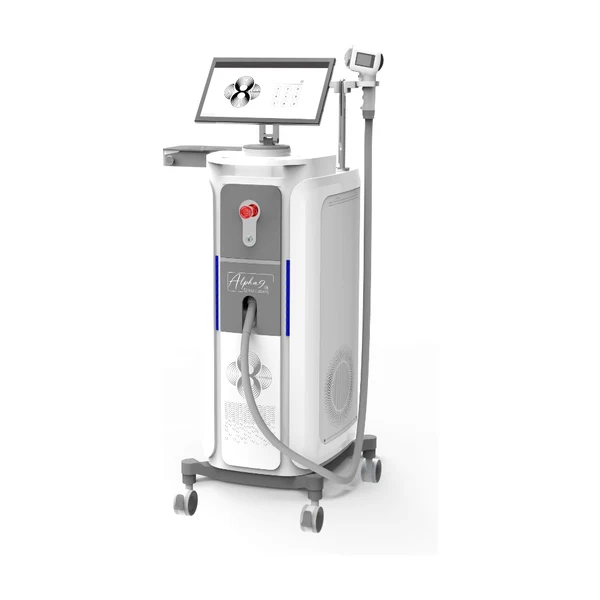
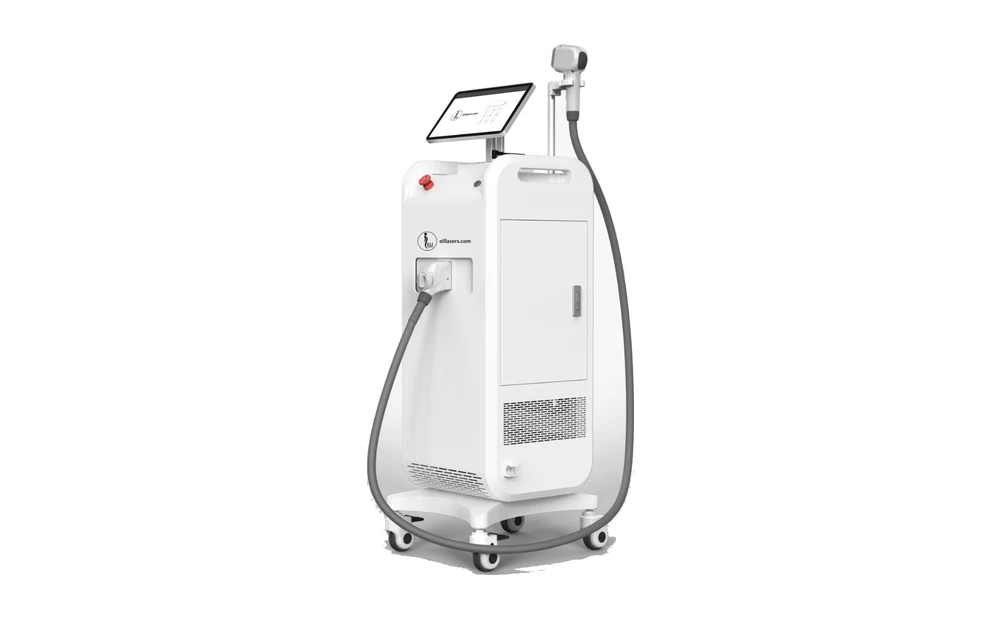
Diode technology has another important advantage — durability and a low cost per treatment — which is why diode devices have become the salon standard. Our line of hair removal lasers is built on diode technology with sapphire contact cooling.
1064 nm — the deepest-penetrating wavelength
The 1064 nm wavelength is the least absorbed by melanin. At first glance that looks like a weakness, but it is in fact an important property: less energy gets "stuck" at the surface of the skin, so this wavelength is used when working on darker skin, and its deep penetration reaches follicles that sit deep. Treatments with it demand more experience from the practitioner, because the weaker absorption in the hair has to be compensated for with other settings.
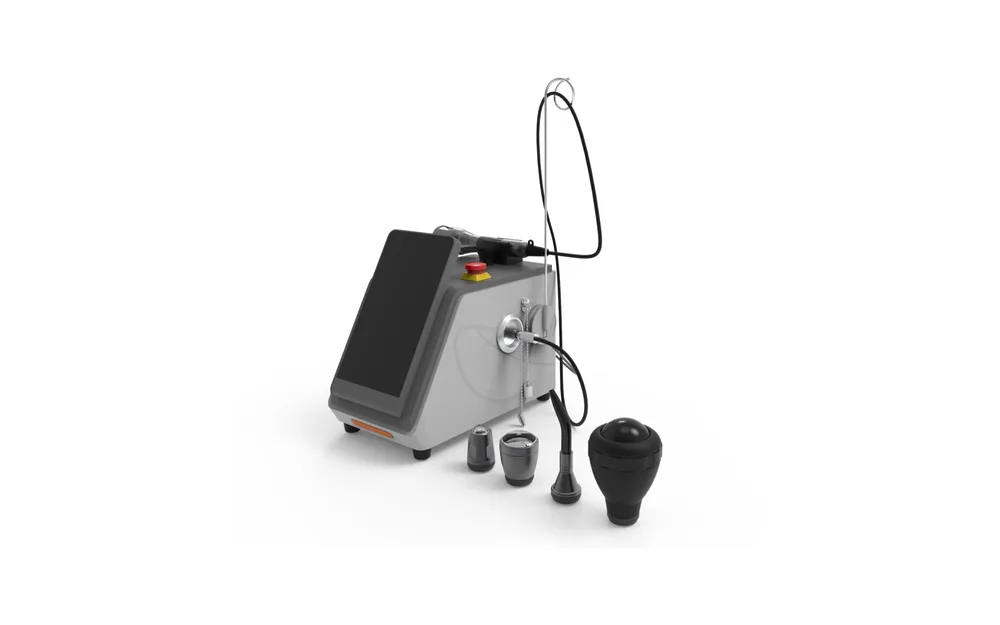
It is worth knowing that 1064 nm is widely used outside hair removal too — it matters in pigment removal as well. Our tattoo and permanent make-up removal laser works precisely on the principle of breaking up pigment, with an extremely short 6 ns pulse.
The comparison in one table
| Wavelength | Absorption by melanin | Penetration | The practical point |
|---|---|---|---|
| 755 nm | Strong | Surface to medium | Effective on fine hair; careful with tanned skin |
| 808 nm | Medium to strong | Medium to deep | The versatile salon standard, a wide range of skin types |
| 1064 nm | Weaker | The deepest | For darker skin and deep follicles; needs experience |
Why wavelength alone is not enough
Wavelength is only one of the parameters that determine the quality of a treatment. Just as important are:
- Power and energy density — they determine whether the follicle receives an adequate dose of energy. The powerful 1200 W handpiece on CLens, for example, allows effective work on large areas, while the 3000 W of ALPHA9™ AI Skin come from fifteen 200 W diodes;
- Pulse settings — controlling them lets you adapt the treatment to the thickness of the hair;
- The cooling system — it protects the skin and determines the client's comfort; we have given the subject its own article;
- The practitioner's competence — choosing settings for the skin and hair type is a skill learned in training. Buy a device from us and it is included in the price.
What this means when choosing equipment for a business
For a practitioner buying equipment, we recommend this line of thinking:
- Assess your client profile — what variety of skin types and hair will predominate in your practice;
- Choose a technology that safely covers as wide a range as possible — in practice that means diode solutions;
- Judge the whole: wavelength, power, cooling, training and service together determine the result, not any one parameter;
- Always confirm the exact technical specifications of your device during a consultation — we will gladly go through them with you alongside the documentation.
We have described the whole equipment selection process step by step in the guide "How to choose a professional hair removal laser", and you can compare the devices here.
The other side of the equation: pulse and energy density
Wavelength governs where the energy goes, but not how much of it there is or how fast it is delivered. Two more parameters come in here:
- Energy density — how much energy falls on a unit of skin area. Too little will not affect the follicle; too much loads the skin. The practitioner's job is to find the balance for the hair thickness and skin type;
- Pulse duration — how long the energy takes to be delivered. In hair removal pulses are measured in milliseconds, so that the follicle has time to heat up. In pigment removal the logic is reversed: the shorter the pulse, the better the pigment is broken up mechanically before the surrounding tissue can heat — which is why the 6 ns (nanosecond) pulse of our tattoo removal laser is millions of times shorter than a hair removal pulse.
The practical conclusion for a buyer: two devices with the same wavelength can work entirely differently — ask about power and about pulse control as well.
Combined wavelengths: why modern devices merge several
The latest generation of diode devices often uses a combination of wavelengths (755+808+1064 nm, for example) in a single pulse. The logic is simple: each wavelength works at its own "depth" — 755 nm catches fine surface hairs effectively, 808 nm covers the main range, and 1064 nm reaches the deepest follicles. The combination lets one device work with a wider variety of hair and skin combinations with fewer changes of setting.
For clients that means a more versatile treatment; for the practitioner, a wider audience with no additional equipment. We wrote about how combined wavelengths also change the sensation during a treatment in our article on differences in discomfort.
Wavelengths and skin phototypes: a practical map
In dermatology, skin tones are classified in phototypes from I (very light, burns quickly) to VI (very dark). The darker the skin, the more melanin at its surface — and the more carefully you must treat the wavelengths that melanin absorbs strongly:
- Phototypes I–III — the widest options: every technology works, 755 nm included;
- Phototypes III–V — the territory of the diode range (808 nm and longer): sufficient effectiveness with far less risk to the surface;
- Tanned skin — a temporary "rise in phototype": treatments are best postponed after active sun exposure, and a course planned so that summer does not interrupt it — another reason salons choose diode devices.
In every case the decision is made by a trained practitioner who assesses the skin in person — which is exactly what we teach in the training included in the price of a device.
Three myths about laser wavelengths
- "The more nm, the better." No — a longer wavelength is not "stronger", it simply distributes differently in the skin. Suitability depends on the client, not on the size of the number;
- "The wavelength determines everything." No — power, pulse control, cooling and the practitioner's hands matter just as much; judge a device as a whole (here is how);
- "An exotic wavelength is a competitive advantage." Careful: rare solutions often mean rare spare parts and difficult servicing. A standard, time-tested range with good support is safer for a business.
How to talk about wavelengths with clients
To a practitioner a wavelength is a technical parameter; to a client it is one more incomprehensible abbreviation. A few tested ways to explain it simply:
- The target analogy: "The laser light aims at the dark pigment in the hair — like a magnet to metal. Different wavelengths simply reach the target at different depths";
- An answer to "will it work for me?": "I will assess your skin and hair at the consultation — the device lets me choose the settings individually";
- An answer to "why will it work here when it didn't elsewhere?": often the reason is not the wavelength but the settings, the regularity or the hair type — an honest assessment of the skin is worth more here than any promise.
Explanations like these build the image of an expert without alarming terminology — and for the most curious clients you can simply send this article.
The essentials at a glance
- Wavelength governs how the energy is shared between hair pigment and skin: 755 nm — strong absorption, 808 nm — the versatile standard, 1064 nm — the deepest and gentlest on the surface;
- No wavelength is "best" — what matters is the fit with your client profile;
- Combined wavelengths in one pulse cover a wider range;
- Wavelength is only one parameter: power, pulses, cooling and the practitioner's hands matter just as much;
- For light hair the answer is not a different wavelength but electrolysis.
Frequently asked questions
Does any wavelength work on light hair?
Unfortunately not — every laser wavelength works through melanin, so laser hair removal is ineffective on very light, grey or vellus hair whatever the wavelength. The answer in that case is electrolysis, which acts on each follicle directly. When it is worth having both technologies is covered here.
Can one wavelength work with every skin type?
Modern diode devices with the right settings and good cooling cover a wide range, but the settings are chosen individually for each client — which is what training and a responsible assessment of the skin before the treatment are for.
What is the difference between hair removal and tattoo removal lasers, if the wavelength is similar?
Pulse duration and the principle of action: in hair removal energy accumulates in the follicle by heating it, while in pigment removal an extremely short pulse (6 ns in our device) breaks up particles of pigment mechanically. They are different tools for different treatments.
Is the wavelength stated in the device's documentation?
Yes — the wavelength is one of the main technical parameters, and you will find it in the device's specification and in the EU conformity documentation. If a supplier cannot state their device's wavelength clearly, or gets confused answering, that is a serious signal about the offer itself. We always discuss our devices' specifications during the consultation, with the documents to hand — transparency here is the norm, not the exception.
Would you like to discuss which solution would suit your practice? Get in touch — the consultation is free, and you can see the equipment in person at our studio in Kaunas. And if you want to see how the theory looks in practice, you can try the devices in real treatments at that studio — the best way for physics to turn into a tangible decision. Book on +370 620 66666 or through the enquiry form — a conversation with a specialist will take less time than reading this article.