
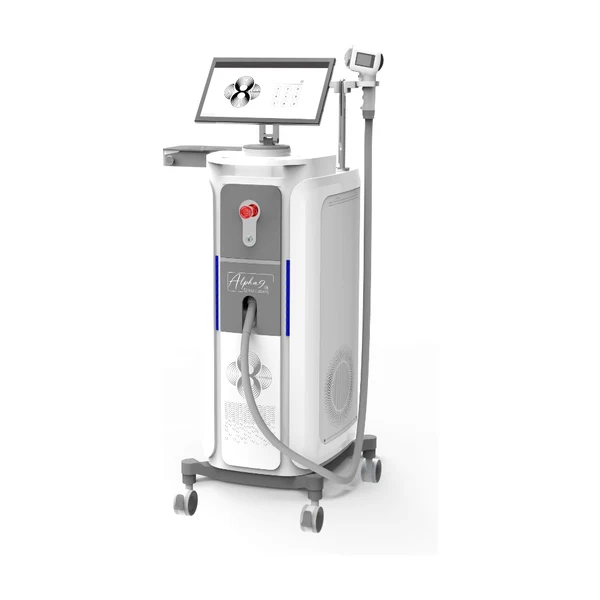
Diode laser
What a diode laser is, how it differs from alexandrite and IPL, what a professional device costs and what to look at before buying.
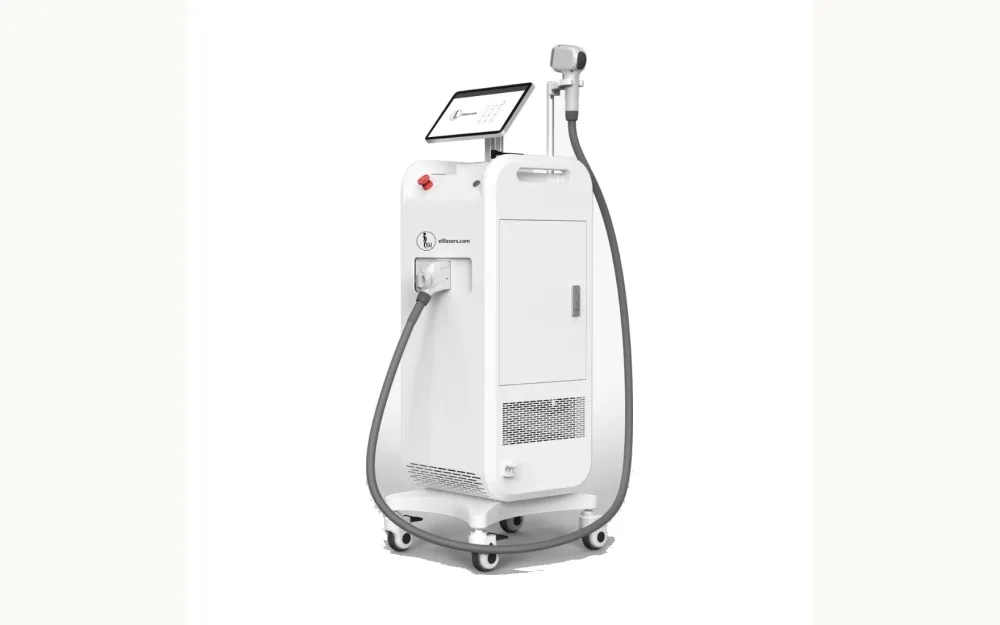
What is a diode laser
A diode laser is a device in which the light is emitted by semiconductor diodes. In hair removal its beam is absorbed by melanin, the pigment in the hair; the light energy turns into heat and damages the hair follicle. Surrounding tissue, which contains less melanin, is left untouched — this is called selective photothermolysis.
In professional laser hair removal the diode laser is today's standard: it works fast, suits a wide range of skin phototypes and is robust enough for daily salon work. Every device we supply is a diode laser.
Wavelengths: 755, 808 and 1064 nm
The wavelength determines how deep the beam travels and how much energy the pigment absorbs. Our devices combine three in one unit:
- 755 nm — very strongly absorbed by melanin, so it suits lighter skin and finer hair.
- 808 nm — the main hair removal wavelength: a balance of depth, speed and safety.
- 1064 nm — travels deepest and is absorbed least by epidermal melanin, making it the safest choice for darker or tanned skin.
Three wavelengths in one device mean the practitioner sets the protocol around the client's skin and hair, not the other way round. More in our guide Hair removal lasers for professionals.
Diode laser price
The price of a professional diode laser depends on power, the number of handpieces, the window size and additional functions. In our catalogue:
| Device | Price incl. VAT |
| ALPHA9™ AI Skin diode laser | €16,500 |
| CLens device with two diode lasers | €14,800 |
| Laser with built-in artificial intelligence | €11,210 |
| Portable DI (portable) | €8,800 |
Every price already includes individual training with a certificate and professional assembly of the device on your premises. Companies registered in Lithuania can use financing through Bigbank, and you can estimate the payback with the calculator.
If you plan to offer tattoo or permanent makeup removal alongside hair removal, look at the CLens+Q — one body holds both a diode laser and a Q-Switched Nd:YAG handpiece.
What raises the price: higher power, two handpieces instead of one, a larger window (faster work over large areas), a stronger cooling system and AI skin analysis.
Diode or alexandrite laser
An alexandrite laser works at 755 nm and is very effective on light skin with dark hair. A diode laser is more versatile: several wavelengths make it safe to work on darker skin as well, and running costs are usually lower because there is no expensive crystal to replace.
In practice, one diode device serves a wider range of clients. We compared the two technologies in detail in Diode vs alexandrite laser.
Diode laser or IPL
An IPL device emits a broad spectrum of light, while a laser emits a concentrated beam of a single wavelength. The laser's energy is therefore aimed more precisely at the hair follicle and fewer treatments are usually needed. For professional work, where speed and a predictable result matter, the diode laser is the stronger choice.
What to look at before buying
- Cooling. A sapphire crystal tip chilling to −10 °C protects the skin surface and keeps the treatment comfortable. Ask what temperature the tip actually reaches.
- Window size. A larger window (for example 15×40 mm) covers legs or a back faster; a smaller one is more precise on the face.
- Power and pulse duration. They decide whether the device can handle both fine and coarse hair.
- Training and service. Check that the supplier provides an EU declaration of conformity, that training is included and who comes out if something fails.
- Warranty. Not only the number of years but also the limit on laser shots.
Not sure where to start? Compare the devices or answer a few questions in the selection guide.
Frequently asked questions
A professional diode laser costs from €8,800 for the compact Portable DI to €16,500 for the ALPHA9™ AI Skin with AI skin analysis. All prices include VAT, individual training and assembly of the device on your premises.
Yes. Both terms describe a laser in which the light is emitted by semiconductor diodes.
The 1064 nm wavelength makes it safe to work on darker and tanned skin. However, a laser works through the pigment in the hair, so it does not work on grey, white or very light hair — that is what electrolysis is for.
On average 6–8 treatments every 4–8 weeks, depending on the area. The laser only affects hair that is in its active growth phase at the time, which is why sessions are repeated.
Thanks to sapphire contact cooling, which chills the skin surface to −10 °C during the treatment, most clients feel only a slight tingling or warmth.
Yes. Companies registered in Lithuania can buy in instalments through Bigbank. Companies that are not registered in Lithuania are welcome to ask about special terms for acquiring a device with part of the payment deferred.