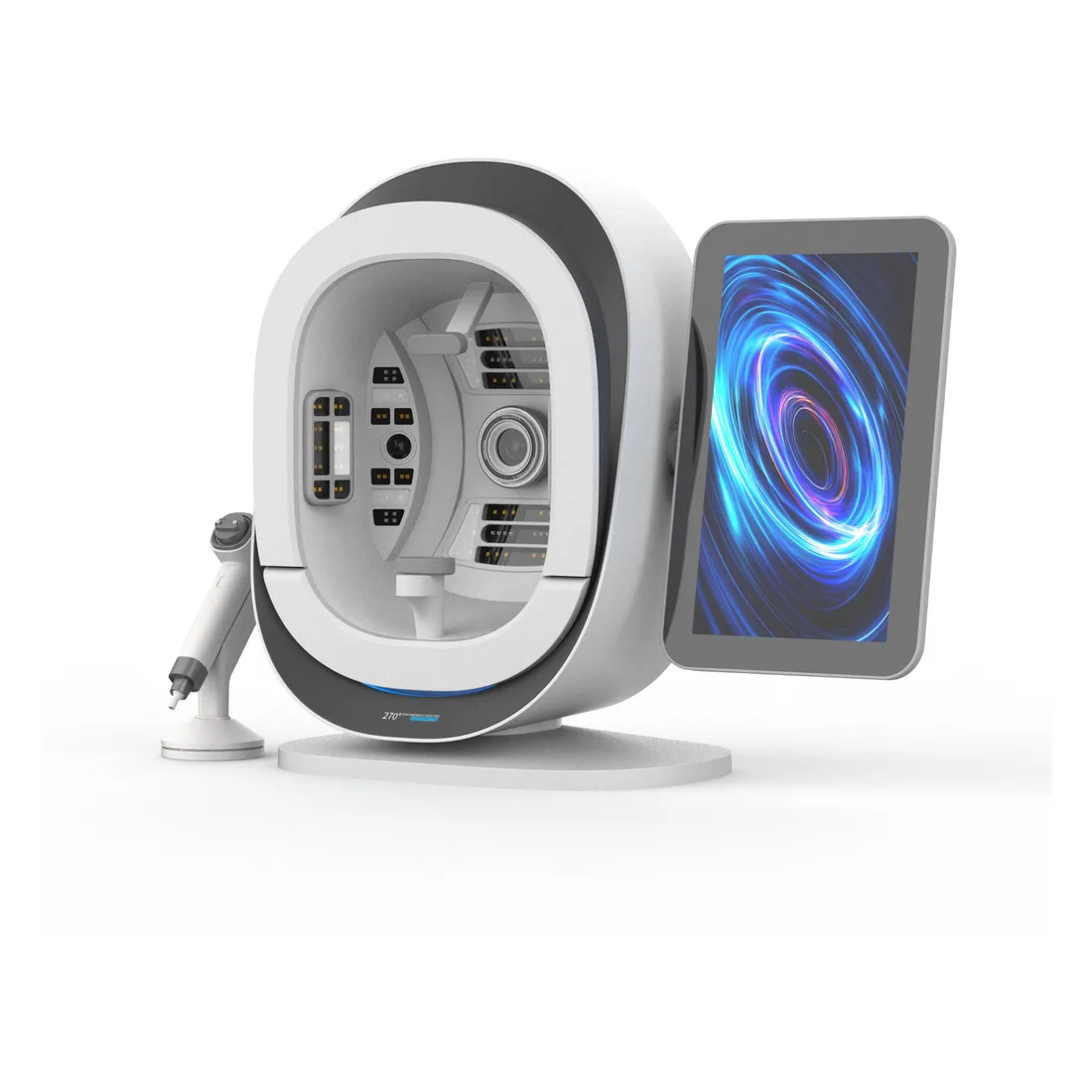
ALPHA9 AI smart skin analyzer – professional facial skin diagnostics
The ALPHA9 AI smart skin analyzer is a professional facial skin diagnostic system for beauty salons, skincare centres and clinics. Eight-spectrum imaging and three facial angles captured at once – front, left and right – give 270° coverage with no blind zones. With one tap the device photographs the skin, analyses it and produces a report the client can open on their phone by scanning a QR code.
- Eight-spectrum imaging
- 270° coverage – three facial angles at once
- 20 skin indicators and 33 detection functions
- Skin age, pH and the Baumann 16 skin types
- Report on the client's phone via QR code
- 15.6-inch touchscreen, Android 11
- Financing for companies registered in Lithuania
How quickly can it pay for itself?
The ALPHA9 AI skin analyzer is diagnostics that helps sell treatments.
The client sees their skin as a mirror never shows it: pigment beneath the surface, the condition of pores, wrinkles, moisture, redness and sensitivity zones. Instead of "I think you should…", the specialist has objective numbers and images, and the client gets a clear report with recommendations.
The device was built to assess skin problems. It combines eight-spectrum imaging technologies and captures three fixed facial angles at once – front, left and right – for 270° coverage with no blind zones. One tap takes the photographs, runs the analysis and produces the report.
The analysis is performed by artificial intelligence models, but the specialist makes the decision about care – the device supplies the data, the images and the recommendations.
Eight spectra – eight ways to see the skin
Each light source reveals its own layer of skin and its own problem:
- White light – surface defects in natural light: acne, spots, wrinkles, pores. Used as the baseline for comparing the other spectra.
- Negatively polarised light – filters out reflection from the skin surface, so light brown, tanned, dark brown and dark red lesions, capillary condition and skin evenness become clearly visible.
- Positively polarised light – enhances surface texture: fine lines, wrinkles, pores, acne scars and unevenness.
- Wood's lamp light – detects deep pigment in the dermis. Melanin does not fluoresce under ultraviolet radiation, so it stands out with greater contrast.
- UV light – reveals porphyrin and fluorescence: helps assess pore problems, skin infections, pigmentary dermatoses and the effectiveness of care.
- Brown light – RBX technology shows the position, area, shape and severity of subsurface UV spots, that is, sun damage and melanin accumulation.
- Red light – analyses subsurface haemoglobin and inflammatory pigmentation: sensitive skin, acne, red vessels.
- Mixed light – polarisation analysis determines the roughness of skin texture and loss of collagen.
270° coverage: three facial angles at once
The device captures three fixed facial angles simultaneously – front, left and right. This builds a 3D panoramic view with no blind zones: not only the cheeks from the front, but also the side areas where sun damage usually accumulates.
A forehead rest and a rotating chin rest hold the client's head, so the next analysis is taken in the same position and the results can be compared with each other.
20 indicators and 33 detection functions
The analysis is grouped into five main areas: ageing, sensitivity, pigment, skin quality and product analysis.
Twenty test indicators: moisture, pores, blackheads, sebum, skin barrier, acne, wrinkles, mixed spots, surface pigment, deep spot map, sun spots, porphyrin, collagen, roughness, deep pigment, brown pigment, sensitivity heat map, sensitivity red map, skin sagging and the jawline.
Every indicator is graded on five levels – A to E – and colour coded from green to red. The report gives the score, level, count, area and share, so the change after a course of treatments is visible in numbers rather than by eye.
Skin age, pH and the Baumann skin type
Skin age is a quantitative measure of actual skin ageing. It is calculated by an AI model trained on samples from people aged 18 and over, and it shows what exactly is ageing: collagen, wrinkles or pigment.
pH – healthy skin is usually slightly acidic (4.5–6.5). This helps determine whether the skin is too acidic or too alkaline, whether its barrier is weakened and whether it is prone to sensitivity, dryness, oiliness and redness.
Skin properties – dry, oily, normal, combination and sensitive. The overall assessment follows the internationally used Baumann classification of 16 skin types, so recommendations rest on the skin type rather than on a single indicator.
Skin tone on the ITA° scale
The device includes a skin colour detection mode: detection algorithms and evaluation parameters adapt to the characteristics of different ethnicities and skin tones, and the multidimensional model view changes with the selected skin colour. The internationally recognised ITA skin tone scale with six levels is used:
| Level 1 (very light) | > 55° — daily sun protection is needed to prevent photo-ageing |
| Level 2 (light) | 41°–55° — skin reddens easily in the sun, constant sun protection is recommended |
| Level 3 (medium) | 28°–41° — healthy, natural and stable tone, basic daily protection is enough |
| Level 4 (tanned) | 10°–28° — skin tans easily, reinforced protection and brightening care are recommended |
| Level 5 (brown) | −30°–10° — bronze, healthy tone prone to hyperpigmentation |
| Level 6 (dark) | < −30° — active melanin production, moisture and skin balance matter most |
Skin prediction: how the skin will look later
Based on the client's current skin condition, an AI model simulates how the skin will look after care and how ageing will progress across different age groups. For the client this is the clearest argument to start a course of care now rather than in a year.
The skin prediction and skin age functions can be switched on or off by the user.
Microscopic examination and deeper layers
A handheld micro-imaging device examines skin detail under three light sources – white, polarised and UV. Both the skin surface and deeper layers are examined; the scalp can also be examined, which opens a separate line of trichology services.
3D slices – a layered scanning and tomographic imaging function that quantifies different skin layers (epidermis, superficial dermis) and shows how problems are distributed in depth.
The profile diagram compares white, negatively polarised and UV light, while the perspective lens lets you compare pigmentation, redness and inflammation between surface and basal skin layers.
A report the client takes home on their phone
The device has three comparison modes and three report modes: a separate standalone report, a detailed analysis report with recommendations, and data comparison between visits.
The client opens the report on their phone by scanning a QR code. The system picks the image for annotation automatically, the text can be edited freely, each indicator's result can be adjusted manually, and the annotation pen marks visible problems on the image (redness or spots, for example). Images can carry a text or picture watermark with your own logo.
A separate product testing function links the analysis to care advice and a programme recommendation, so the analysis turns naturally into a sale.
Client records and salon statistics
The management system stores client profiles, freely recorded care procedures and examination records that can be reviewed and edited in real time. Several devices can be managed in one system.
The data centre shows how many clients visited during a month or a year, their age distribution, the ratio of men to women and the share of problems for each indicator. A separate function lists the clients whose birthday falls on that day.
Data is stored in the cloud, images can be exported one by one or in groups, and the interface language can be changed by the user.
Who the device is for
Medical beauty institutions, skincare centres and cosmetics customer service points, facial ageing analysis, verification of the effect of anti-ageing products, and support for research and experiments.
It pairs well with treatment equipment: an analysis taken before and after a course of skin rejuvenation with the ALPHA9™ AI Skin laser shows the change in numbers for you and in images for the client.
Specifications
| Purpose | Professional facial skin analysis and diagnostics |
| Image sensor | Industrial grade, 36 megapixels |
| Light spectra | 8: white, positively and negatively polarised, Wood's lamp, UV, brown, red, mixed |
| Captured angles | 3 at once (front, left, right), 270° coverage |
| Test indicators | 20 |
| Detection functions | 33 |
| Skin type classification | Baumann, 16 skin types |
| Skin tone scale | ITA°, 6 levels |
| Shading | Lowering hood |
| Display | 15.6 inch, 1920 × 1080, 16:9, folds back to 90° |
| Control | Multi-touch capacitive touchscreen |
| Interface languages | Lithuanian, English, Spanish, German, French, Italian, Portuguese, Dutch, Polish, Turkish and Russian |
| Operating system | Android 11 (R10-S6810 board) |
| Processor | RK3568, quad-core Cortex-A55, up to 2.0 GHz |
| Memory (RAM) | Dual-channel LPDDR4, 4 GB |
| Storage | MMC 5.1, 32 GB |
| Connectivity | Dual-band WiFi (2.4 and 5 GHz), 1 × HDMI, 3 × USB |
| Power supply | AC 100–260 V, 50/60 Hz |
| Housing material | Industrial grade ABS |
| Dimensions | 695 × 305 × 569 mm (folded 516 × 402 × 569 mm) |
| Weight | 11.4 kg (17.1 kg with packaging) |
| Packaging | 665 × 600 × 530 mm, corrugated cardboard and EPE foam |
| Other accessories | Moisture measuring handle, power cable |
| Warranty | 1 year |
Frequently asked questions about the ALPHA9 AI skin analyzer
It is a professional facial skin diagnostic system for beauty salons, skincare centres and clinics. It photographs the skin in eight spectra, evaluates twenty indicators using AI models and produces a report with recommendations.
The client rests their head on the forehead and chin rests, and with one tap the device photographs the face from three angles, runs the analysis and creates the report. Coverage reaches 270° with no blind zones.
White light, negatively and positively polarised light, Wood's lamp light, UV light, brown, red and mixed light. Each spectrum reveals a different layer of skin: from surface texture to deep pigment and subsurface haemoglobin.
Twenty: moisture, pores, blackheads, sebum, skin barrier, acne, wrinkles, mixed spots, surface pigment, deep spot map, sun spots, porphyrin, collagen, roughness, deep and brown pigment, the sensitivity heat and red maps, skin sagging and the jawline.
Hydration is measured with a separate contact handpiece using bioelectrical impedance analysis (BIA). The handpiece has two electrode points that touch the skin and measure its electrical resistance, which indirectly gives the moisture level. Every other indicator is calculated from the photographs taken under the eight light spectra. The hydration handpiece is included in the package.
Collagen is calculated by image-analysis algorithms, from the same photographs taken under eight different light spectra. No separate sensor is needed for it.
Yes. The client opens the report on their phone by scanning a QR code. The specialist can edit the text and each indicator's result, mark problems on the image with the annotation pen, and add a watermark with your own logo.
Yes. Skin age is calculated by an AI model (samples from age 18 upwards) and shows what exactly is ageing. pH helps assess whether the skin is too acidic or too alkaline and whether the barrier is weakened; healthy skin is usually 4.5–6.5.
It is an internationally used system that sorts skin into 16 types (dry or oily, sensitive or resistant, pigmented or not, wrinkle-prone or not). The device gives its overall assessment in this system, so recommendations rest on the skin type rather than a single indicator.
Yes. The device has a skin colour detection mode that adapts detection algorithms and evaluation parameters to the skin tone. The ITA° scale with six levels is used, from very light to dark skin.
Yes. The device has three comparison modes and keeps the examination history, and every indicator is graded on five levels from A to E. Fixed capture angles mean images from different visits are comparable.
The analysis ends in recommendations: the product testing function links the problems found to care advice and a programme recommendation, while the skin prediction shows how the skin will look with care and without it. The client decides while looking at images of their own skin.
Yes. The management system stores client profiles, treatment and examination records that can be reviewed in real time; the data centre shows visitor numbers, age distribution, the ratio of men to women and the share of problems. Data is kept in the cloud and several devices can be managed in one system.
Power AC 100–260 V, 50/60 Hz and dual-band WiFi. The device is a desktop unit: 695 × 305 × 569 mm, 516 × 402 × 569 mm folded, weighing 11.4 kg, so an ordinary desk is enough. A moisture measuring handle and a power cable are included.
Yes. You can build your own product catalogue and give each item a brand, a name, an image and a price. The device shows only your own catalogue — not the manufacturer's or any third party's products.
Yes. The device settings let you adjust the parameters and decide which indicators drive the recommendations — for example moisture, skin barrier, pigmentation or sensitivity. That way the advice follows your own skincare method.
Yes. Once the test procedure has been learned, a single practitioner can run the device without an assistant.
Yes. Treatments can be entered manually in the management system — you sign in with the same email address and password used to activate the device.
Records are kept in the cloud, and the servers are located in the European Union. The device has to be connected to the internet to work. Client data can be deleted on request. Data storage is free of charge.
The warranty is 1 year. Within the warranty period, if the fault lies with the device itself, we replace the parts free of charge; if the damage was caused by improper use, or the warranty has expired, the cost of parts is the customer's. Software issues are resolved remotely. The software, the cloud services and the updates are included in the price of the device — there are no mandatory paid subscriptions. Updates are released periodically, with no fixed schedule.
API integration is possible, but it is a separate paid service agreed case by case. Without it, test results cannot be exported as JSON or CSV, and the data behind the QR report cannot be read by another application. If you plan to connect the device to your own system, send us your requirements and we will assess them separately.
Yes. As with all our equipment, individual training on the device is included in the price, and for three months after purchase we provide free telephone support.
Yes, for companies registered in Lithuania – through the Bigbank platform. Companies registered elsewhere can enquire about special terms for acquiring a device with part of the payment deferred.
Similar equipment

Have a question?
Our specialists will answer any question about the equipment, training and financing quickly and properly.