
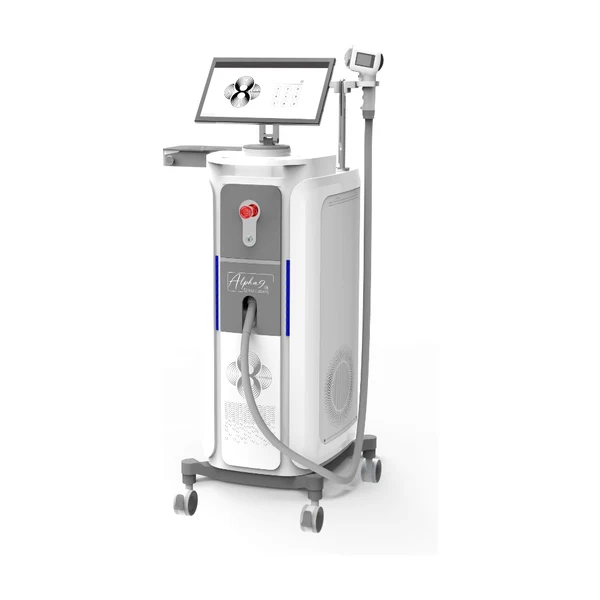
Permanent makeup removal laser
How permanent makeup is removed with a laser, which wavelength suits which pigment, how many treatments are needed and what the device costs.
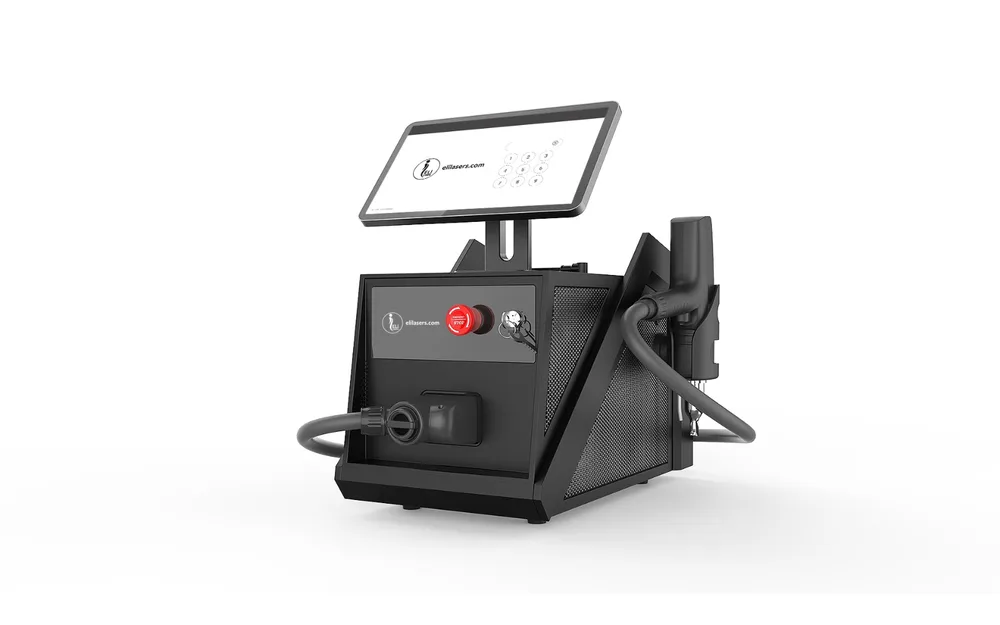
How a laser removes permanent makeup
Permanent makeup pigment sits in the dermis, so it does not fade away on its own. A laser pulse hits the pigment particle so briefly that the particle shatters into microscopic fragments while the surrounding skin has no time to heat up. Over the following weeks the fragmented pigment leaves the body naturally through the lymphatic system.
The tool for this is a Q-Switched Nd:YAG laser. What matters is not power but how short the pulse is: the shorter the pulse, the stronger the shock wave inside the pigment and the less heat reaches the skin.
Wavelengths and pigment colours
Pigments of different colours absorb different wavelengths, so no single wavelength covers everything:
- 1064 nm — dark pigments: black, dark blue, grey. This is the main wavelength for removing brow and eyeliner PMU.
- 532 nm — warm pigments: red, brown, orange. These are what usually remain in lip PMU and in brows that have changed colour.
- 1320 nm — used for skin rejuvenation and "Carbon Peel" treatments.
All three wavelengths are in the device we supply, so one unit handles both dark and warm pigment.
Why the 6 ns pulse matters
Pulse duration is the single most important parameter in PMU removal. The shorter it is, the more the pigment is broken apart mechanically rather than heated — and heating is the main cause of scarring and skin damage.
Our device has a 6 ns pulse. That is an exceptionally short pulse for a non-medical device; only medical picosecond lasers go shorter. It is what makes the device suitable for a beauty salon or an aesthetics studio, not only a clinic.
Brows, lips and eyeliner
- Brows. The most common request: old, greenish or too dark PMU. Usually treated at 1064 nm, with 532 nm for any remaining brownish tone.
- Lips. The pigment is warm, so 532 nm is used. The area is more sensitive and sessions are shorter.
- Eyeliner. Requires the most precise work and mandatory eye protection — only ever done with dedicated eye shields.
A test patch is always done before the first session: some light and white pigments can darken under the laser, and it is better to see that on a small area.
How many treatments are needed
Removing permanent makeup usually takes 3–8 treatments, carried out every 6–8 weeks. The exact number depends on the depth, amount and colour of the pigment and on how many times the PMU was refreshed.
Tattoos normally need more sessions than PMU because the pigment layer is thicker. More on that in the tattoo and PMU removal equipment section.
The device and its price
Technical data:
| Laser type | Q-Switched Nd:YAG |
| Power | 800 W |
| Wavelengths | 1064 nm, 532 nm, 1320 nm |
| Pulse duration | 6 ns |
| Energy | up to 1200 mJ |
| Cooling | built-in system, down to 5 °C |
| Warranty | 2 years on the device, 1 year on the laser |
| Price | €6,800 incl. VAT |
The same Nd:YAG laser is also in the CLens+Q — a device that pairs it with a diode laser for hair removal.
The price includes individual training with a certificate and professional preparation of the device on your premises. Companies registered in Lithuania can use financing through Bigbank.
Frequently asked questions
The device costs €6,800 including VAT. The price includes individual training with a certificate and preparation of the device on your premises.
Usually 3–8 treatments every 6–8 weeks. The number depends on the depth, amount and colour of the pigment and on how many times the PMU was refreshed.
Dark pigments are treated at 1064 nm and warm ones (red, brown, orange) at 532 nm. Light, white and skin-toned pigments can darken under the laser, so a test patch is always done first.
Yes, the same Q-Switched Nd:YAG laser removes tattoos and performs "Carbon Peel" treatments. Tattoos usually need more sessions because the pigment layer is thicker.
This is not a medical device, so the requirements that apply to medical picosecond lasers do not apply to it. We go through the hygiene requirements that apply to your particular practice during the consultation.
Yes. Training is individual, for 1–2 people, one day of theory and practice, with course materials and a certificate. More in Training and support.